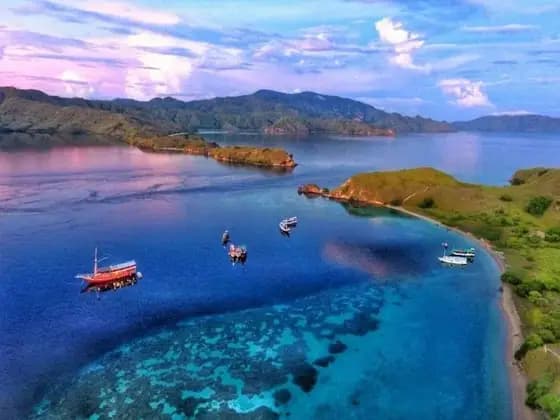

Pulau Padar Komodo offers Indonesia's most dramatic sunrise viewpoint, reachable via a 30-45 minute hike from the beach to three turquoise bays. The best light hits the ridgeline between 5:45 and 6:15 AM during dry season (April–November), when golden hour illuminates the island's signature tri-color beaches. This guide covers everything from pre-dawn boat departures to composition tips our captains have refined over eight years of Komodo island tours.
| Fact | Detail |
|---|---|
| Location | Komodo National Park, East Nusa Tenggara, Indonesia |
| Elevation Gain | ~220 meters (721 feet) from beach to main viewpoint |
| Hiking Time | 30–45 minutes up; 20–30 minutes down |
| Best Season | April–November (dry season, clearest skies) |
| Sunrise Window | 5:30 AM departure from boat; 6:00–6:30 AM peak color |
| Trail Difficulty | Moderate; 750+ wooden and stone steps, some loose scree |
| Entry Fee | Included in Komodo National Park ticket (IDR 500,000–1,000,000 depending on weekdays/weekends) |
There is a particular quality of light on Padar Island Indonesia that you will not find elsewhere in the archipelago. At 5:47 AM in late June, the first rays strike the eastern ridge not as a gradual brightening but as a sudden blade of amber cutting through the Savu Sea haze. The temperature drops ten degrees from the afternoon furnace; your breath still visible in short clouds, the air carrying iodine and dry grass from the island's upper slopes.
I have made this hike perhaps two hundred times over seven years operating Phinisi yacht charters from Labuan Bajo. The summit never repeats itself. Some mornings, cumulus builds behind the Gili Lawa islands and the light fractures into crepuscular rays. Other days, the horizon clears entirely and the transition from indigo to molten gold takes ninety seconds flat.
The sensory architecture of a Padar sunrise begins before you leave your cabin. At 4:45 AM, the diesel generator cuts out on most liveaboard boats, replaced by the slap of wavelets against the hull and the first coffee grinder from the galley. By 5:15, you transfer to the tender in darkness, the water so still it mirrors Orion upside-down. The beach landing is wet—always wet, regardless of tide, because the crew judges the swell and runs the bow onto black volcanic sand so you can step dry-shod in deck shoes.
Most Komodo sailing trips anchor in Padar's northern bay overnight, positioning for a 5:30 AM tender departure. The distance from Labuan Bajo harbor to Pulau Padar Komodo is 40 nautical miles; sailing time ranges from 6–8 hours depending on your vessel and prevailing southeast trades. This is why overnight positioning matters—you cannot make sunrise from a same-day departure.
Our captains at KomodoExplorer.com prefer anchoring at coordinates 8°39.2'S, 119°34.5'E, in 12 meters of water over sand. This position minimizes tender transit to five minutes and provides shelter from the prevailing easterlies that build after 9:00 AM. If your luxury yacht charter anchors farther south in the second bay, add fifteen minutes to your departure time.
The beach landing is tide-dependent in ways that surprise first-time visitors. At spring low tide, the black sand shelf extends forty meters, requiring a longer tender run followed by a wet wade. At high tide, the surge pushes directly against the staircase base—safer for disembarkation but more challenging for the return when the sun has heated the rocks and your legs are fatigued.
We schedule departures around the tide tables published by Bakorkamla Denpasar, not generic apps. Local knowledge matters: a 0.8-meter tide with a 1.2-meter swell from the southwest creates different conditions than the same tide with easterly chop. Your Komodo boat tour operator should brief this the evening before.
The trailhead begins at a weathered wooden arch where fishermen once hung squid to dry. The first section is deceptively gentle—compressed sand giving way to crushed coral, then the first granite steps installed by park authorities in 2018. These steps are uneven, ranging from 15 to 40 centimeters in height. I advise clients to find a rhythm immediately: short steps, breathing in through the nose, out through the mouth. The humidity at sea level is 85% even at dawn; you will sweat.
The soundscape shifts within minutes. The beach surf fades, replaced by figbird calls from the Ficus canopies below the ridge. During fruiting season (January–March), you may hear the heavy wingbeats of megabats returning to roost, though they are rarely visible in pre-dawn darkness.
The gradient steepens dramatically. Here the trail builders switched to timber cribbing filled with local stone, creating steps that flex slightly underfoot when dry and become slick as polished glass after rain. There are 347 steps in this section by my count—yes, I have counted them during slow groups—rising 140 meters in horizontal distance of perhaps 80 meters.
The middle platform at 20 minutes is where most photographers make their first error. The view is already spectacular: the northern bay visible, its water shifting from ink to teal as your eyes dark-adapt. But this is not the summit. Groups that stop here miss the layered perspective that makes Pulau Padar Komodo iconic. I tell clients: "Coffee later. Light now."
Above the middle platform, the vegetation thins to Themeda grassland and scattered Euphorbia. The trail becomes scree and exposed granite, marked by white paint blazes that are invisible until headlamp beams catch them. This is where fitness separates groups. The final 40 meters of elevation gain feel steeper than the first 180 because of oxygen debt and the psychological weight of knowing the summit is close.
The ridgeline itself is knife-sharp volcanic tuff, weathered into undulations that create natural seating positions. Arrive by 5:50 AM and you will have your choice of perch. By 6:05, the ridge accommodates perhaps thirty people comfortably; by 6:15 during peak season (July–August), it becomes a shoulder-to-shoulder exercise in mutual accommodation.
The classic Padar shot requires three elements in balance: the foreground ridge line leading the eye, the middle-ground tri-bay configuration, and background atmospheric haze providing depth. The 24–70mm equivalent range handles most situations; wider introduces excessive foreground distortion that bends the ridgeline unnaturally.
What the postcard images do not convey is the vertical scale. From the main viewpoint, the drop to the central beach is 220 meters straight down. This creates a natural vignetting effect when you position low and shoot upward, emphasizing the amphitheater shape. I have seen clients spend twenty minutes at the absolute summit only to discover that ten meters back along the trail, the composition opens dramatically with grass tufts for foreground interest.
April–May: The sun rises north of east, illuminating the northern bay first while the southern bays remain in shadow. This creates a chiaroscuro effect that rewards bracketed exposures. Humidity is moderate; visibility often exceeds 30 kilometers.
June–July: The solstice sun tracks directly through the channel between the Gili Lawa islands. On clear mornings, you can photograph the solar disk framed between volcanic cones—a composition that requires precise timing, as the window lasts perhaps four minutes.
August–October: Haze increases from agricultural burning on Flores. This is not entirely negative: the diffused light reduces contrast in the shadowed bays, revealing detail that harsh direct sun would burn out. The trade-off is reduced clarity in distant layers.
November: The transitional month offers the most unpredictable and potentially rewarding conditions. Monsoon moisture builds in afternoon but often clears by dawn, creating inversion layers that pool in the bays like liquid mercury.
Bring a tripod only if you are committed to pre-sunrise blue-hour photography. The ridgeline wind gusts to 25 knots by 7:00 AM, making long exposures problematic without weighting the center column. I prefer a beanbag braced against volcanic rock for stability, or simply accepting ISO 800–1600 for hand-held work.
Polarizing filters are counterproductive at sunrise—the low sun angle already minimizes reflections, and the filter robs two stops of precious light during the critical color phase. Save the polarizer for post-sunrise when you descend to beach level and photograph the bays in direct light.
After hundreds of departures, our Komodo tour packages include a standard briefing, but personal preparation matters:
Most visitors retrace their steps to the tender and depart for Komodo dragon tours or Pink Beach snorkeling. The more rewarding route continues along the ridgeline saddle to the southern viewpoint, then descends a secondary trail to the central bay—Padar's least visited beach.
This trail is not officially maintained and requires route-finding across two dry streambeds. The reward is a crescent of coral sand entirely absent of footprints at 7:30 AM, with snorkeling over undisturbed Acropora tables at the bay's eastern end. We include this variation on our private yacht charter itineraries when clients request extended beach time.
For photographers dissatisfied with the crowded sunrise, the western ridge offers complementary conditions from 8:00–9:30 AM. The sun then illuminates the bay interiors directly, revealing the color gradients that give Padar Island Indonesia its reputation: volcanic black sand in the northern bay, powder coral in the central, and the faint pink tint of Foraminifera fragments in the southern.
Access requires backtracking from the summit and traversing a goat path that our guides maintain with quarterly machete clearing. This is not independently discoverable; it requires local knowledge or guided trekking support.
Twenty to thirty boats anchor nightly. The summit experience becomes communal rather than solitary; you will hear German, Mandarin, French, and Bahasa Indonesia in overlapping conversation. The light is reliable, the trails dry, the visibility excellent. Book Komodo liveaboard capacity six months ahead.
My preference. April offers post-monsoon clarity with occasional afternoon thunderstorms that clear by dawn. September brings the first returning manta rays to nearby Manta Point, allowing combined itineraries. November's unsettled weather produces the most dramatic cloud formations—gamble that rewards patience.
Padar remains accessible but the experience changes fundamentally. Pre-dawn cloud cover reduces sunrise probability to perhaps forty percent. When clear, however, the atmospheric clarity after rain is unmatched. Trails become genuinely hazardous; we provide trekking poles and modify routes. Some Komodo dive trips substitute Padar for Rinca Island trekking during sustained wet periods.
The trail is moderate in objective terms but demanding in context. The pre-dawn start, humidity, and psychological pressure of catching sunrise amplify the physical challenge. We have guided clients in their sixties who completed it comfortably with pacing, and twenty-something athletes who underestimated the heat retention and struggled. The key variable is not fitness but preparation: adequate sleep the night before (difficult on a moving boat for first-timers), hydration begun the previous evening, and realistic expectations about the step irregularity. Our Komodo sailing tour crews carry emergency radios and can coordinate tender pickup at the middle platform if needed.
Same-day departure is not feasible for sunrise viewing. The 40-nautical-mile distance requires overnight positioning in Padar's anchorage. Departures from Labuan Bajo typically occur between 12:00–2:00 PM the previous day, allowing afternoon Kelor Island snorkeling and sunset positioning. If you are on a day trip from Labuan Bajo, you will arrive at Padar mid-morning and should adjust expectations to landscape photography rather than sunrise.
Crowding follows predictable patterns. July–August weekends with favorable tide timing see the ridgeline at capacity. Mitigation strategies: visit in shoulder season, request your yacht charter captain anchor for a Tuesday or Wednesday departure (fewer liveaboards in port), or accept the secondary western viewpoint with slightly reduced grandeur but near-total solitude. Private charters offer scheduling flexibility that group open trip Komodo departures cannot match.
The summit rewards minimalism. A mirrorless body with 24–105mm equivalent covers 90% of compositions. The critical accessory is a headlamp for pre-hike setup and a microfiber cloth for lens condensation that forms rapidly in the humidity transition from beach to ridge. Drone operation is technically prohibited in Komodo National Park without special permit; our luxury liveaboard packages include permit assistance for serious photographers, but enforcement is inconsistent and we advise against unpermitted flight.
Yes, and you should. The central bay offers the best snorkeling with healthy hard coral at 3–5 meters depth and occasional hawksbill turtle sightings. The northern bay has stronger surge and requires caution. Water temperature ranges 27–29°C year-round. We schedule 45–60 minutes post-hike before departing for Taka Makassar or Manta Point, allowing recovery swimming and second breakfast on board.
The difference between a generic Komodo itinerary and an exceptional one lies in these pre-dawn hours. The logistics of positioning, timing, and trail knowledge separate memorable photography from disappointed social media posts. At KomodoExplorer.com, we have refined our Padar protocols through eight years of operational feedback, adjusting tender types, anchor positions, and departure buffers based on seasonal pattern analysis.
Our Phinisi yacht fleet maintains permanent mooring priority in Padar's northern bay, a relationship with park authorities built through consistent compliance and guide training investment. When you book a Komodo island hopping package with sunrise guarantee, we commit to overnight positioning and 5:15 AM coffee service regardless of group size.
The light on Pulau Padar Komodo is not guaranteed—no natural phenomenon is. But the probability of extraordinary conditions, multiplied by proper preparation and local knowledge, produces outcomes that justify the pre-dawn alarm. The summit ridge at 5:55 AM, wind in the grass, three bays materializing from darkness below: this is why we operate in these waters.
Ready to witness Padar Island Indonesia at its most transformative hour? Browse our sunrise-optimized Komodo yacht charters and reserve your preferred dates for the coming dry season.