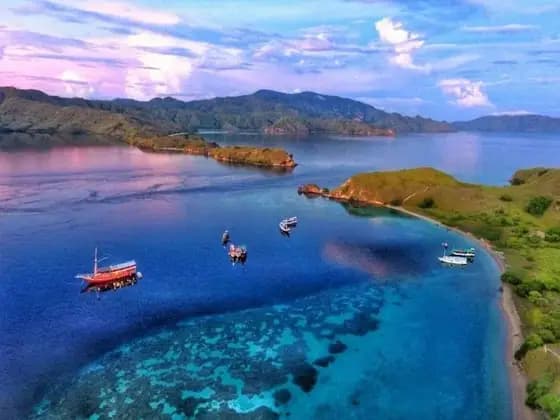

A paket lombok komodo tour is a multi-day sailing journey from Lombok to Labuan Bajo aboard a traditional Phinisi yacht, typically spanning 3–4 days and covering the Lesser Sunda Islands' most spectacular marine and terrestrial landscapes. This route combines world-class diving, Komodo dragon encounters, and pristine beach experiences that are inaccessible by land-based travel. For travelers seeking the definitive Indonesian archipelago adventure, a lombok komodo liveaboard represents the most immersive and efficient way to experience this UNESCO-recognized region.
| Feature | Details |
|---|---|
| Route Distance | Approximately 250 nautical miles (463 km) |
| Typical Duration | 3 days / 2 nights to 4 days / 3 nights |
| Departure Point | Senggigi or Teluk Nara, Lombok |
| Arrival Point | Labuan Bajo, Flores |
| Best Season | April–November (dry season, southeast monsoon) |
| Key Stops | Moyo Island, Satonda, Gili Banta, Komodo National Park |
| Diving Certification | Open Water minimum; Advanced recommended for Batu Bolong |
| Vessel Type | Traditional Phinisi wooden schooner, 20–40 meters LOA |
The overland alternative—flying from Lombok to Labuan Bajo—sacrifices everything that makes this region extraordinary. You miss the sulfur-tinged dawn light over Sangeang Volcano, the bioluminescent wake on moonless nights, and the gradual transition from Lombok's verdant highlands to Flores' arid, dragon-haunted coastlines.
I've guided this route for eight seasons, and the psychological shift passengers experience is remarkable. Day one, everyone checks their phones compulsively at Senggigi harbor. By day three, anchored off Gili Lawa Darat with no signal for 48 hours, the same guests are identifying tropicbirds by silhouette and arguing about the optimal deck position for sunset.
The lombok komodo liveaboard route also solves a genuine logistical problem. Lombok's northern coast and the Komodo National Park form a natural continuum of marine biodiversity that simply doesn't exist elsewhere in Indonesia. The Wallace Line's influence is palpable here—you'll photograph orchids on Moyo Island that grow nowhere else on Earth, then dive Komodo's currents alongside oceanic manta rays within 36 hours.
Departure timing is critical. We cast lines from Teluk Nara at 0700, catching the dying land breeze before the southeast trades fill in around 1000. The passage to Moyo Island takes six to eight hours depending on conditions, and I always advise guests to stay on deck for the approach.
Moyo's waterfall—Mata Jitu—requires a tender ride up the Sungai Moyo estuary. The water smells of wet basalt and decomposing fig leaves, a sharp contrast to the salt-crusted air of the open deck. The falls themselves plunge 30 meters into a pool where we've documented juvenile blacktip reef sharks cruising in the brackish outflow.
Insider tip: Visit the waterfall before 0900. The morning light penetrates the canopy at approximately 15 degrees, illuminating the calcite formations that give Mata Jitu its "crystal waterfall" nickname. After 1100, the pool is crowded with speedboat day-trippers from Sumbawa Besar, and the experience degrades significantly.
Satonda Island presents one of the most peculiar geological features in the Lesser Sundas—a saltwater crater lake formed by volcanic eruption approximately 10,000 years ago. The rim hike takes 45 minutes at moderate pace, and from the summit, you can observe the stratified water column: fresh rainwater floating atop denser marine incursion.
The lake's edge is lined with waringin trees whose aerial roots descend like organic scaffolding. Local tradition holds that these trees were planted by Bugis sailors in the 19th century, though dendrochronological evidence suggests earlier cultivation. Regardless, the visual effect is haunting—stunted forest growing from volcanic tuff at the waterline.
We typically reach Gili Banta by late afternoon, anchoring in the lee of the island's western ridge. The snorkeling here is exceptional for a non-diving activity: parrotfish grazing on Acropora tables, the occasional white-tip reef shark patrolling the drop-off at 8 meters depth. The sand on Gili Banta's eastern beach has a distinctive olive cast from volcanic glass content—it doesn't stick to skin the way coral-derived sands do, and the texture underfoot is almost silky.
This is where a paket lombok komodo tour distinguishes itself from shorter Labuan Bajo-based itineraries. Arriving from the south, we enter the park through the Loh Dasami channel, typically at slack water to avoid the 4-knot currents that rip through this constriction.
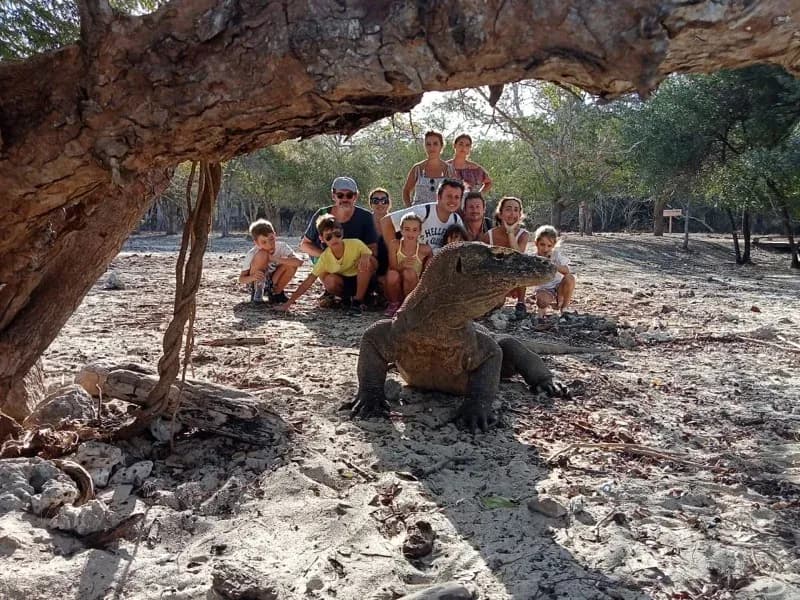
Our first Komodo dragon encounter usually occurs at Loh Buaya on Rinca Island. The rangers here are more flexible than at Komodo Island's Loh Liang, and we can arrange early morning treks that begin at 0600—before the heat drives the Varanus komodoensis into shaded lethargy. I've observed dominant males at this hour with body temperatures still low enough that their movement is deliberate, almost mechanical. The forked tongue flicks with metronomic regularity, testing air columns for carrion scent.
The afternoon dive at Batu Bolong is non-negotiable for certified divers. This seamount rises from approximately 75 meters to break the surface at low tide, and the vertical walls concentrate pelagic life with almost aquarium-like density. I've logged over 200 dives here and still encounter species I cannot immediately identify. The key is timing: we aim for the high-water slack, when the upwelling has ceased but the nutrient load remains concentrated.
Padar Island's viewpoint has become justifiably famous, though the standard midday visit is a mistake. We land at 0530, headlamps cutting through the residual humidity of night, and begin the 30-minute ascent in darkness. The reward is sunrise from the central spine, with the island's three bays—one black sand, one white, one pink—gradually resolving through the atmospheric perspective.
The pink beach derives its color from Foraminifera tests mixed with coral fragments. Under direct sunlight, the effect is subtle, almost disappointing to some visitors. But in the oblique light of early morning, the roseate tone is unmistakable, particularly where wave action has concentrated the foram-rich fraction at the high tide line.
We typically make Labuan Bajo harbor by 1600, allowing sufficient time for customs clearance and guest disembarkation before the evening flight window.
These vessels, typically 20–25 meters LOA with 4–6 cabins, represent the authentic lombok komodo liveaboard experience. Construction is ironwood and teak, with shared bathrooms and open-air dining. The trade-off is genuine: you sacrifice air conditioning and en-suite facilities for a vessel that sails as Phinis have sailed for centuries.
I've operated on standard Phinis where the generator failed for 36 hours. Guests adapted—deck showers with bucket-heated water, meals cooked on the kerosene backup stove, conversations by flashlight. The experience, inconvenient in retrospect, often becomes the most vividly recalled portion of the voyage.
KomodoExplorer's fleet includes vessels like Kapal Phinisi Mewah options with individually controlled cabin climate, dive compressors, and professional camera rinse stations. These 30+ meter vessels carry 12–16 guests with crew ratios approaching 1:1.
The substantive difference isn't the amenities—it's the operational flexibility. A luxury Phinisi carries sufficient fuel and water for extended anchorage at remote sites. We can wait out weather at Gili Lawa for three days if the diving warrants, or divert to Sangeang for an unscheduled volcano snorkel when conditions align.
For private charter, we deploy converted research vessels or purpose-built aluminum hulls with 5,000+ nautical mile range. These sewa kapal phinisi options include submersible operations, helicopter decks, and dedicated expedition leaders. The cost structure places them in the "special occasion" category—honeymoons, milestone celebrations, or photographic expeditions with specific species targets.
The Padar viewpoint hike and the Rinca dragon trek both demand moderate fitness. More critically, diving in Komodo's currents requires comfort with negative entries and controlled descents. We recommend arriving in Lombok with at least 20 logged dives for the full itinerary, though discover scuba options exist at Moyo and Satonda.
Water temperature varies significantly along the route. Moyo's protected bays may reach 29°C in October, while Batu Bolong upwellings can drop to 24°C. I advise a 3mm full suit with hooded vest, plus a 5mm option for photographers who remain stationary during long exposures.
Our peralatan diving page details KomodoExplorer's rental inventory, though I strongly recommend personal mask and computer. The mask fit is idiosyncratic, and dive computers vary in algorithm conservatism—knowing your equipment's behavior at depth is safety-critical in Komodo's decompression environment.
Komodo National Park requires pre-registration for all visitors. Our operations team handles this for booked guests, but independent travelers should note that daily quotas apply during peak season (July–August). The park fee structure (approximately USD 15/day for international visitors) is collected in cash at ranger stations—Indonesian Rupiah only, exact change appreciated.
The paket lombok komodo route crosses distinct biogeographic zones, and species composition shifts predictably:
Moyo to Satonda (Sumbawa Sea): Cleaner wrasse stations at depth, pygmy seahorses on Muricella fans, occasional dugong sightings in the seagrass meadows east of Moyo.
Gili Banta to Komodo (Flores Sea transition): Manta ray cleaning stations at Makassar Reef (though this is typically accessed from Labuan Bajo-based itineraries, we can divert north if conditions permit). More reliably, Gili Banta's northern wall hosts Napoleon wrasse and the occasional thresher shark at dawn.
Komodo National Park proper: The full spectrum—oceanic mantas at Manta Point, dugong at Siaba Besar (rare but documented), the endemic Komodo walking shark (Hemiscyllium halmahera) at night dive sites. I've also recorded blue-ringed octopus, flamboyant cuttlefish, and multiple Rhinopias species within single dive days.
Seasonal note: Manta presence at Karang Makassar correlates with plankton blooms, typically strongest during southwest monsoon (December–March). Our musim terbaik diving analysis provides monthly probability matrices.
The lombok komodo liveaboard route traverses waters that have supported maritime trade for millennia. Bugis, Bajo, and Makassarese communities maintain living connections to these seascapes.
At Wera on Sumbawa's north coast—sometimes included as an optional stop—we visit a boatbuilding village where Phinisi construction continues using adzes and traditional caulking ( calafate with damar resin and cotton). The smell of fresh-sawn ulin ironwood, sharp and almost metallic, mingles with the sulfur from Sangeang's distant plume. Children sell ikat textiles woven with sea-spun cotton; the indigo dyes are fermented in seawater, a technique I've not encountered elsewhere in Indonesia.
These encounters are increasingly curated, increasingly photographed. I ask our guests to consider the transaction: your presence supports continued craft practice, but also transforms it. Purchase deliberately, engage respectfully, and recognize that the "authentic" experience you seek is itself a negotiation between preservation and adaptation.
Komodo's light quality rewards preparation. The dry season haze, combined with equatorial sun angle, produces a distinctive warm cast during the "golden hours" that bracket nautical twilight. I shoot with a custom white balance of 5200K during these periods, warming further in post-processing.
Underwater, the challenge is spectral absorption. Below 10 meters, red wavelengths are effectively absent; strobes or video lights become essential for color accuracy. Our fotografi bawah air workshops, conducted during transit between sites, cover strobe positioning for wide-angle reef scenes and macro techniques for pygmy subjects.
Drone operation is permitted in Komodo National Park with prior authorization—our operations team secures this for charter guests. The regulatory landscape shifts frequently; current requirements include proof of liability insurance and pre-programmed flight plans.
Komodo National Park faces genuine pressure from increased visitation. Our paket lombok komodo operations incorporate several mitigation strategies:
Anchor protocols: We use established moorings at all possible sites, deploying our own sand screws only in designated areas. The ironwood hulls of traditional Phinisi are relatively benign if grounding occurs—unlike steel or fiberglass—but we avoid this entirely through careful chart work and local knowledge.
Waste management: All KomodoExplorer vessels operate "zero discharge" policies for plastics and greywater. Organic waste is compacted and returned to Labuan Bajo for processing; we do not dispose of food scraps at sea, contrary to some operators' practices that attract conditioned wildlife.
Community benefit: Our crew recruitment prioritizes Flores and Sumbawa residents, with training pathways from deckhand to dive guide to captain. The tanggung jawab sosial page details our partnership with marine education programs in Labuan Bajo's coastal villages.
Pricing for lombok komodo liveaboard experiences spans approximately USD 150–800 per person per night, depending on vessel category, season, and inclusions.
| Tier | Vessel Type | Approximate Rate (per night) | Typical Inclusions |
|---|---|---|---|
| Budget | Standard Phinisi, shared cabin | USD 150–250 | Meals, basic snorkeling, park fees |
| Mid-Range | Standard Phinisi, private cabin | USD 250–400 | Meals, diving (3–4 dives/day), equipment |
| Premium | Luxury Phinisi | USD 400–600 | En-suite cabin, all diving, nitrox, camera room |
| Ultra-Premium | Expedition yacht / private charter | USD 600–800+ | Full charter flexibility, helicopter, submersible |
These figures are indicative; our harga paket komodo page provides real-time availability and seasonal adjustments. The value proposition of the Lombok departure is substantial—shorter Labuan Bajo-based itineraries often cost comparably but include less diving and no inter-island transit experience.
International access is via Lombok International Airport (LOP) with direct connections from Singapore, Kuala Lumpur, and major Indonesian hubs. From the airport, our operations team provides transfer to the departure harbor—typically 90 minutes to Teluk Nara. Many guests combine their paket lombok komodo with prior exploration of the Gili Islands or Mount Rinjani trekking; we can coordinate multi-day packages with flexible departure dates.
Absolutely. The route's appeal extends well beyond scuba. Snorkeling quality at Moyo, Satonda, and Gili Banta rivals many dedicated dive sites globally. Kayaking, paddleboarding, and simply the experience of traditional sailing in remote archipelagos satisfy many guests. We do recommend trying a discover scuba session if health permits—Komodo's underwater visibility and marine density create ideal introductory conditions.
Three days and two nights represents the functional minimum. This allows Moyo, Satonda, and a single Komodo site, but feels compressed. Our most booked lombok komodo liveaboard is four days/three nights, which permits Rinca dragon trekking, multiple Komodo dive sites, and Padar Island without rushed transits. Five-day options add Sangeang volcano and more flexible weather contingencies.
The dry season window (April–November) offers predictable conditions, with peak reliability June–September. July and August require 3–4 month advance booking for preferred vessels. Shoulder months (April–May, October–November) provide excellent diving with fewer vessels at each site—my personal preference for photography. December–March is technically possible but involves routing adjustments for monsoon patterns; we operate reduced schedules with experienced crews during this period.
Private charter allows complete flexibility—dedicated macro photography, extended diving at specific sites, or incorporation of Sumbawa surf breaks. On scheduled departures, we accommodate requests within operational constraints. Whale shark encounters at Saleh Bay (Sumbawa) require specific tidal timing and add approximately 12 hours to the transit; this is feasible on 5+ day private charters but not standard group departures. Contact our [